

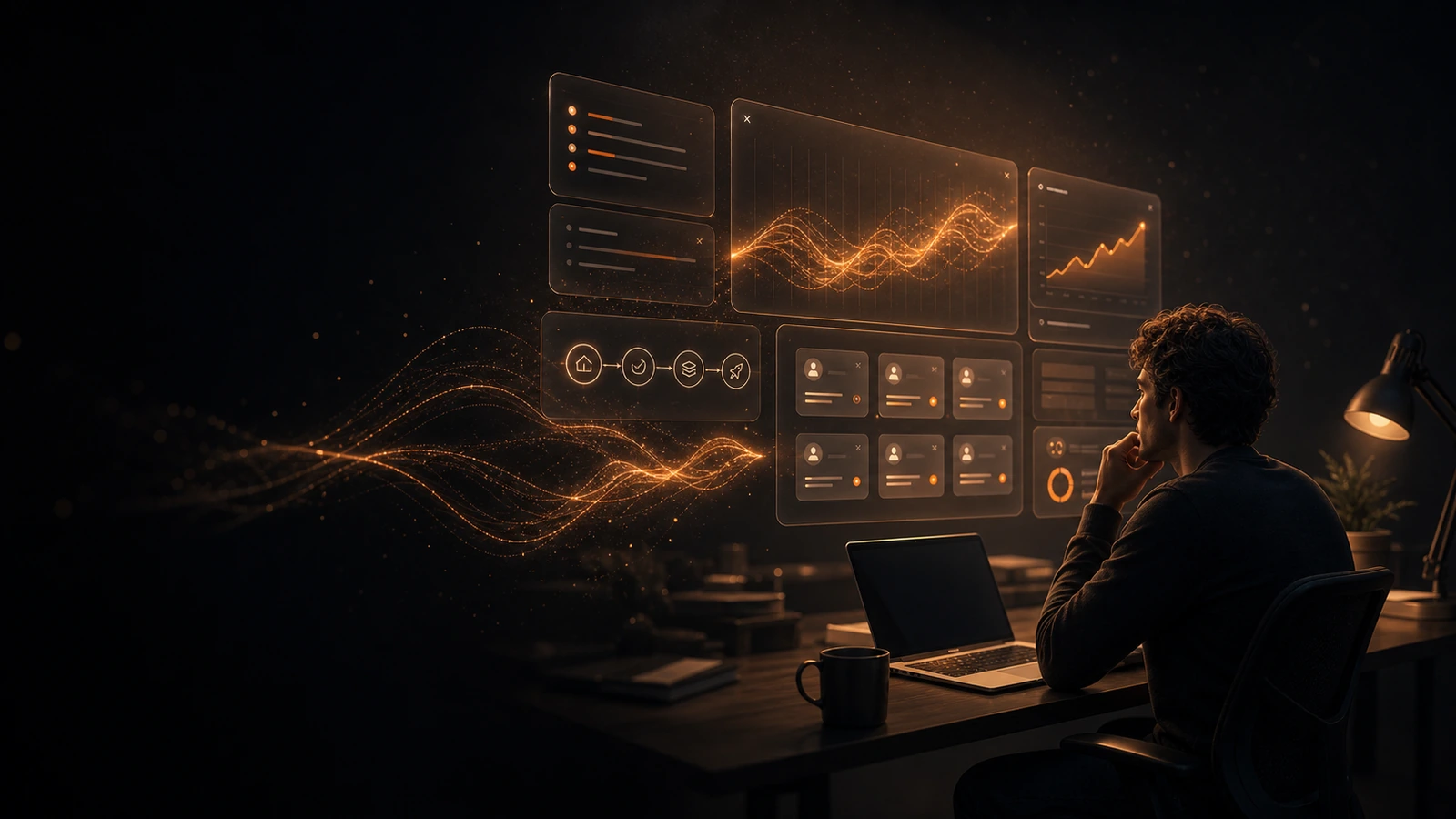
Puro Ops
Our own operating system: a private dashboard that holds the whole company on one screen. JSON files are the source of truth, edits happen by telling Claude what changed in chat, and Vercel rebuilds in half a minute. Not publicly accessible; a model for the internal-ops layer we build into client engagements.
Running a studio means holding a lot of state in your head: what's in the pipeline, what's stuck, who's owed what, which decisions are still open. We'd tried the usual project tools and they all became the thing nobody updated. So we built our own: one private dashboard (Pulse, Pipeline, Tasks, Projects, Clients, Team, Finance, Decisions) that is the single screen for running Puro AI Labs.
- 01
Every ops tool we'd used before died the same death: it became a second place to maintain, so it stopped getting maintained. The new one had to be effortless to update or it would meet the same fate.
- 02
We didn't want a database or an admin UI. The state of the company should be plain, versioned, diffable; something we can read in a pull request, not query.
- 03
Updates needed to happen in the flow of work. If logging a change means opening a tool, finding the row, and editing a field, it won't happen consistently.
- 04
It's private company data; access had to be gated, and the whole thing had to cost effectively nothing to run.
The source of truth is a folder of static JSON files: pipeline, tasks, clients, finance, decisions, all of it. Updating the dashboard means telling Claude in chat what changed; Claude edits the JSON, commits, and pushes; Vercel rebuilds in about 30 seconds. Refresh on a phone and you've got the live state of the company. Access is password-gated. There's no database to administer, no admin panel to build, and every change to the company's state is a versioned diff you can read back later. It's the same JSON-as-truth, chat-as-interface pattern we now reach for whenever a client needs an internal ops layer that won't rot.
Used every day to run the studio. The pipeline doesn't slip because updating it is a sentence in chat, not a chore. Finance, tasks, clients, and open decisions all live on one screen that's one refresh from current. It costs effectively nothing to run, every change is in git history, and it's become the reference build for the kind of operator-grade internal dashboard we put into client engagements.
More work
Want something like this for your business?